

Automated award interpretation enables payroll teams to focus on more critical compliance auditing.
Payroll teams often spend much of their time manually calculating penalty rates, overtime, allowances, and other award entitlements. With the introduction of automated award interpretation software, the payroll role is changing. Instead of manual off-system calculations and keying in data from disparate systems, teams can now focus on what matters most: auditing and compliance validation. This is a critical change because getting award calculations wrong is costly. The Fair Work Ombudsman recovered $358 million for 249,000 underpaid workers last financial year, and intentional underpayment is now a criminal offence with penalties of up to $7.8 million for corporations. By adopting automated award interpretation, payroll teams can reduce errors and focus on verifying that the system applies the rules correctly.
The Compliance Burden of Modern Awards

Australia’s modern award system is one of the most complex in the world. Over 120 individual modern awards cover different industries and occupations, each with its own set of minimum wages, penalty rates, overtime provisions, allowances, and classification structures. Many businesses also operate under enterprise bargaining agreements (EBAs) or custom agreements that layer additional conditions on top of the relevant award.
Manually tracking all these rules is a significant challenge. Data from Inzenius’ blog notes a high rate of non-compliance, usually not due to deliberate wrongdoing but to the difficulty of accurately interpreting and applying award rules across a workforce with varying rosters, ages, and classifications.
The financial and reputational risks of non-compliance are severe. Beyond the criminal penalties for intentional underpayment, back-pay bills can run into hundreds of thousands of dollars. There is also the administrative burden of responding to compliance audits and rectifying past errors. Payroll managers spend countless hours checking timesheets, referencing award provisions, and cross-referencing employee rosters to ensure calculations are correct. This manual process is slow and error-prone, so many organisations are turning to technology to automate award interpretation.
How Automated Award Interpretation Changes the Payroll Workflow
From Manual Entry to System-Driven Calculations
Automated award interpretation software takes the complex clauses of the business’s award or enterprise agreement and converts them into system rules that the payroll engine can apply automatically. When an employee clocks in and out, or when timesheets are approved, the software calculates the correct pay entitlements, including penalty rates, overtime, allowances, and any other applicable loadings. This removes the need for payroll staff to manually look up award provisions for every pay period. As Appoyo defines it, automated award interpretation converts modern award clauses into system rules that payroll software can apply automatically. The result is significantly reduced calculation time and lower error risk.
Several vendors offer different approaches to this automation. KeyPay provides a library of pre-built modern awards and a pay conditions engine that allows businesses to build custom enterprise agreements. Microkeeper takes a more controlled approach: the user must interpret the award and set the rules themselves, but once those rules are set, they apply consistently. The Access Group offers a fully configurable Award Engine suitable for multi-award operations, while Deputy allows auto-filling of key award entitlements, including penalty rates, overtime pay, and allowances, in just a few clicks.
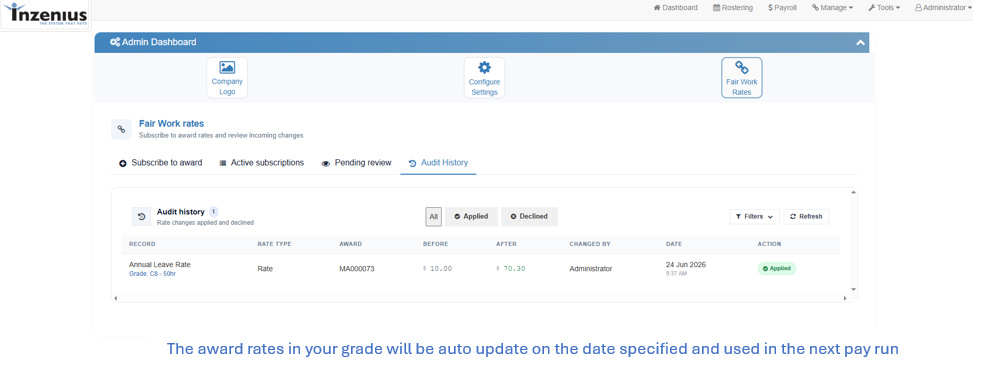
Inzenius all-in-one Rostering and payroll system streamlines payroll data collection and supports direct upload from the Fair Work award rate API into the business setup to maintain compliance with the configured rates.
Each approach reduces manual processing effort to varying degrees, but the balance between automation, comprehensiveness, and user control varies.
The key is the capability to collect data accurately and completely for full award compliance, from rostering to timesheet approvals, configured to the needs of the business. Automating the actual pay to the award for automated BOOT comparison is an added feature to ensure pay compliance for each and every employee
Real-Time Cost Visibility and Error Reduction

One of the most valuable outcomes of automated award interpretation is real-time workforce cost visibility. Systems like Inzenius software calculate costs, including penalties, overtime, and allowances, as rosters are built, so managers can see the financial impact of scheduling decisions before they are finalised. This visibility helps prevent budget blowouts and reduces the likelihood of month-end payroll surprises. On error reduction, Microkeeper claims its software can cut payroll errors by up to 95% and halve payroll processing time. While individual results will vary, these figures illustrate the potential efficiency gains that automated award interpretation can deliver.
Each Payroll Solution has its strengths and weaknesses; however, the automated payroll Award Interpretation needs to be able to handle all of the award interpretation cases to comply with the regulations and conditions in agreements
Each solution has strengths that suit different types of businesses. For example, businesses with simple award coverage may prefer a pre-built library like Deputy, while those with complex EBAs might need a more configurable engine like Inzenius as an Australian-grounded, award-winning payroll calculation engine for Australian conditions. The important thing is that the software supports the specific awards and agreements that apply to your employees.
Auditing and Compliance Validation Become the Core Task
When the system handles the award calculations automatically, the payroll team’s role shifts from manual processing to reviewing exceptions and validating compliance. Instead of spending hours calculating penalty rates line by line, payroll staff can run reports that highlight discrepancies between what the system calculated and what the employee should have been paid under their award. Some platforms include built-in audit trails that record every calculation step, making it easier to demonstrate compliance during a Fair Work inspection.
For example, it will include a salary annualisation feature that will track discrepancies between award entitlements and actual pay. This lets payroll teams quickly identify potential under- or overpayments and rectify them before they become compliance issues. KeyPay also emphasises audit readiness, with features that help businesses stay aligned with Fair Work updates. As a result, payroll professionals will be able to spend their time interpreting exceptions, training managers on rostering decisions, and ensuring the ongoing accuracy of the system’s rules, rather than rekeying data.Choosing the Right Solution for Your Business

Choosing the Right System
Pricing Considerations
Pricing for automated award interpretation software varies widely. Most highly complex award-capable providers do not publish standard pricing and instead require a demo or quote. Businesses should compare costs not only on a per-employee paid each period, like Inzenius does with an average cost of between Aus $4.00 to $5.30 per pay slip created each period, including full Australian support services, depending on the function required, but also consider any implementation fees, annual commitments, and the cost of integrating with existing accounting or HR systems. Other vendors charge extra for support or advanced features such as salary annualisation or multi-award support.
Legal and Compliance Emphasis
Payroll compliance with award conditions, even for salaried employees based on the times they work, is not an option with the costs of remediation and underpayments so high for the business and its leadership.
When evaluating providers, it is also important to understand how each vendor handles compliance updates. Modern awards change periodically, and the software must reflect those changes. Inzenius can automate pay run updates published directly by the Fair Work Commission, updating all clients simultaneously when laws and rates change. Most other vendors rely on the payroll team to stay informed of award changes and to implement rule updates within the software. Microkeeper, for example, puts the user in control of rule interpretation, meaning the business retains responsibility for ensuring the rules are correct. KeyPay and the Access Group both stress compliance with Fair Work regulations and audit readiness. Regardless of the vendor chosen, it is wise to confirm how often award updates are released and whether the vendor will proactively apply them or simply provide tools for users to do so.
The Realities and Limitations of Automation
Automated award interpretation software is a powerful tool, but it does not eliminate all risk. No system can replace the need for a knowledgeable payroll professional to oversee the process. Payroll System vendors still require the user to set up employee classifications correctly, enter rosters and timesheets accurately, and review pay runs for anomalies. Even with fully automated interpretation, a unique clause in an enterprise agreement may not be captured correctly, or an award update may not be applied in time. The $160 billion “complexity tax” cited by Employment Hero refers to employment red tape generally, not specifically to the costs of interpreting awards.
Businesses should treat automated award interpretation as a powerful assistant that reduces the risk of error and frees up time for compliance auditing, not as a complete replacement for payroll expertise. Regular audits of the system’s calculations, spot checks on random employees, and ongoing training for rostering managers are still essential practices. Vendors such as Tambla WFM describe their award interpretation as automated, accurate, and compliant, but that compliance depends on the user ensuring the system is set up correctly in the first place.
Frequently Asked Questions
What is automated award interpretation?
Automated award interpretation software converts the written clauses of a modern award, enterprise agreement, or custom pay rule into system calculations that payroll software can apply automatically. When employee timesheets are approved, the software calculates correct penalty rates, overtime, allowances, and minimum hourly wages without manual lookup or manual formula entry.
How does award interpretation software reduce payroll errors?
By removing the need for payroll staff to manually calculate award entitlements each pay period, automated award interpretation reduces human error. Some system providers claim their software reduces payroll errors by up to 95%. The system applies the same rules consistently to every employee, largely eliminating errors caused by misreading award clauses or miskeying rates.
Does award interpretation cover all 122 modern awards?
Some vendors monitor all 120+ modern awards in real time. Other vendors offer pre-built libraries for a wide range of awards, but may not cover every single one. Businesses should confirm with the vendor whether the software supports the specific award (s) applicable to their employees, especially if they operate in niche industries.
Can the software handle enterprise bargaining agreements (EBAs) and custom pay rules?
Yes, many award interpretation platforms allow users to create custom pay rules or use a pay conditions engine to build enterprise agreements. Inzenius offers a pay conditions engine for custom EBAs. 2cloudnine supports modern awards, custom agreements, EBAs, and even international awards. Microkeeper lets users set their own rules manually for any agreement.
Is automated award interpretation software expensive?
Pricing varies widely. Inzenius charges $4.00 and $5.30 per active employee per pay slip for its all-in-one rostering, timekeeping, timesheet award interpretation and payroll, including support services, Other vendors like Microkeeper, 2cloudnine, and the Access Group do not list public prices and require a demo. The cost often depends on the number of employees, the complexity of awards, and the level of support needed.
Adopting automated award interpretation lets payroll teams move beyond repetitive data entry and focus on the high-value work of auditing and compliance validation. With real-time cost visibility, error-reduction claims of up to 95%, and the ability to quickly identify underpayments before they become legal issues, the software helps businesses reduce risk and improve payroll efficiency. The shift from processing to auditing is a significant change, but one that pays dividends in both time saved and peace of mind.