

Australian businesses that rely on manual payroll calculations face a persistent challenge: keeping up with the complex rules embedded in modern awards and enterprise agreements. Even a small miscalculation in penalty rates, overtime, or allowances can lead to underpayments, compliance breaches, and time-consuming corrections. Automated award interpretation addresses this problem directly by converting award clauses into system rules that payroll software can apply automatically. This approach ensures that every hour recorded on a timesheet is interpreted correctly, reducing the need for off-system calculations and eliminating many of the errors that plague manual processes.
What Automated Award Interpretation Means for Your Business
Automated award interpretation uses software to apply Australian Modern Award rules in real time. Instead of a payroll officer manually checking each employee’s hours against a printed award schedule, the system handles the mapping automatically. It calculates time-in-lieu, rostered days off, penalty rates, overtime, and allowances based on the specific award or agreement that applies to each employee. This process converts complex legal language into precise payroll outcomes, removing much of the guesswork and risk from the pay run.
For businesses where labour costs exceed 30 per cent of revenue, the accuracy of these calculations has a direct impact on profitability. A system that interprets awards correctly from the approved timesheet means managers can trust the numbers without needing to double-check every entry off-system. This saves time for payroll teams and reduces the likelihood of errors that can lead to costly remediation later.
Why Complete Accuracy from the Approved Timesheet Matters
The starting point for any payroll calculation is the employee’s contracted rostered worktimes and their approved and accepted timesheet. If the award interpretation is not fully accurate from that point, errors compound quickly. Off-system calculations require manual intervention, which introduces the possibility of oversight. Even a single missed penalty rate or overtime threshold can result in an incorrect pay amount.
Complete award and leave interpretation from the approved timesheet is a must to minimise off-system calculation times and errors. When an automated award interpretation engine handles this processing, it applies the rules consistently every time. There is no variation between pay periods or between different staff members performing the same work. This capability and consistency are difficult to achieve with many award engines that are not designed to handle the depth and breadth of award conditions in Australia and New Zealand. Manual methods of enhancing incomplete award interpreters or manual off-system calculations and data entry create risks of errors and omissions. Payroll needs to ensure all the conditions and rates are being interpreted correctly.
The benefits of automated award interpretation can extend beyond accuracy. It simplifies the accuracy of the complex data collection and retention process from rostering to payroll and saves time by eliminating manual effort for managers and payroll staff. Instead of spending hours verifying that all data is collected and applied in the system for automated award classifications and penalty rate applicability, payroll professionals can focus on more strategic tasks, such as workforce planning and cost management.
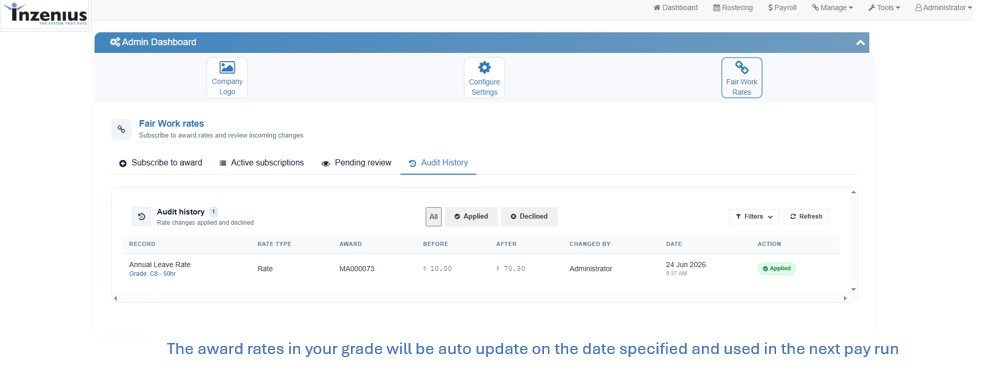
Having rostering as a core component of the payroll system ensures compliance with the employee and award conditions. The ability to also automate the updated award rates across all of the payroll conditions is a key to the timely accuracy and efficiency of the system
How Automated Award Interpretation Works in Practice
The process begins when an employee clocks in or submits a timesheet through a time-and-attendance system. The software captures the hours worked, including the start and finish times and any breaks. It then applies the relevant award rules based on the employee’s classification and the specific provisions of the modern award or enterprise agreement.
These rules cover a wide range of pay conditions, including:
-
Multiple engagements in one shift for employees’ rosters and timesheets
-
Employee allocation to shifts based on availability, qualification and permissions
-
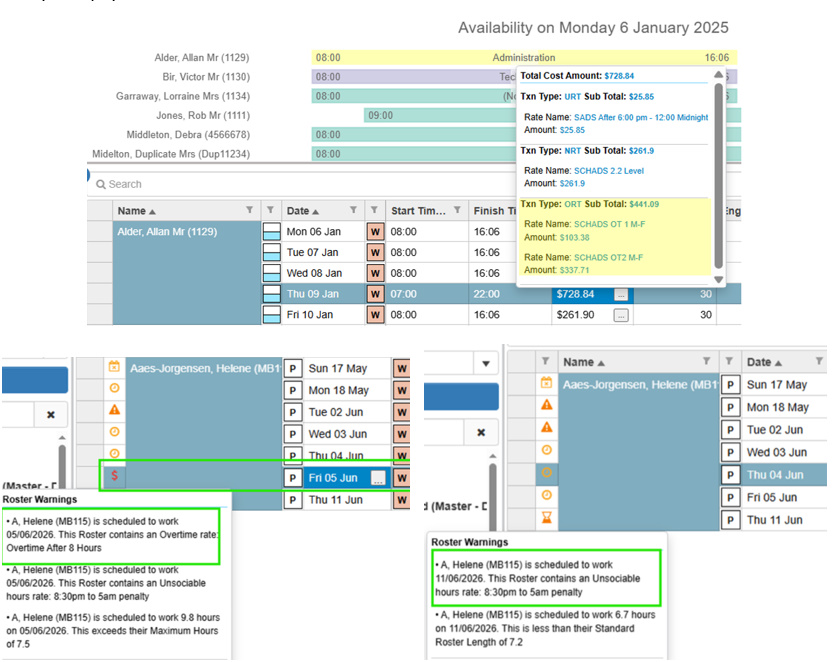
Dynamic interpretation of the shift costs, highlighting when penalties are payable
-
Engagement activity tracking of department, cost centre, position, activity and event
-
Ordinary hourly rates
-
Penalty rates for weekends, public holidays, and late shifts
-
Overtime calculations based on daily or weekly thresholds
-
Averaging of overtime over more than one pay period automation
-
Allowances for specific tasks or conditions
-
Leave entitlements such as annual leave, personal leave, and long service leave
-
Time-in-lieu accruals and rostered day off arrangements/
-
Automated layered varied allowances at the employee, location, department and position
Because the system applies these rules automatically, the payroll process becomes faster and more reliable. Managers can see workforce costs in real time, including penalties, overtime, and allowances, which helps with budgeting and rostering decisions. This real-time visibility also supports better compliance with the Fair Work Act and other relevant laws.
Reducing Manual Errors Through Automation
Manual payroll processing is prone to mistakes. A tired payroll officer working late on pay day might overlook a specific allowance or apply the wrong penalty rate. These errors can accumulate over time, leading to significant underpayments or overpayments. Automated award interpretation helps reduce manual errors by mapping hours worked against award rules and flagging any discrepancies before the pay run is finalised.
This reduction in errors is not just about avoiding financial losses. It also protects the business from compliance risks. The Fair Work Ombudsman takes underpayment seriously, and even unintentional breaches can result in penalties, back-pay obligations, and reputational damage. By automating award interpretation, businesses can demonstrate that they have taken reasonable steps to comply with their obligations.
The system’s accuracy depends on the quality of the award interpretation engine. A well-designed, market-knowledgeable engine will be updated regularly to reflect changes in modern awards and legislation. This is important because award conditions change over time, and keeping up with those changes manually is difficult. An automated system that receives regular updates ensures that the business remains compliant without requiring staff to track every amendment themselves.
Real-Time Cost Visibility for Better Decision Making
One of the advantages of automated award interpretation is the ability to see labour costs as they accrue. When the system knows which award rules apply to each employee, it can calculate the cost of each shift in real time. This information is valuable for managers who need to make rostering decisions on the fly.
For example, a hospitality manager deciding whether to bring in an extra staff member for a busy Friday night can see exactly what that decision will cost, including penalty rates and any applicable allowances. This visibility helps with budgeting and ensures that labour costs remain under control. Without automated award interpretation, the manager would need to estimate the cost manually, which often leads to surprises at the end of the pay period.
Industries That Benefit Most from Automated Award Interpretation
While any service business that uses modern awards or enterprise agreements can benefit from automation, shift-based service industries have particularly complex award structures, making manual interpretation challenging. These include:
-
Hotel, hospitality and catering, where shift times vary widely, and penalties apply for late-night and weekend work
-
Healthcare and aged care, where staff work across multiple rosters and classifications
-
Eduction
-
Event management and venue operations, where irregular hours are common
-
Farming and agriculture, where seasonal work and variable hours create complexity
-
Call centres, where shift patterns and allowances must be tracked carefully
For businesses in these sectors, the effort required to calculate pay correctly can be substantial. The risk of errors is also higher because of the number of variables involved. Automated award interpretation reduces that risk and makes the payroll process more efficient.
Setting Up Award Rates in Your System
Good award interpretation software allows administrators to set up award rates in a few clicks. The system can auto-fill key award entitlements for each employee, including penalty rates, overtime pay, and allowances. This saves time during the initial setup and ensures that new employees are classified correctly from the start.
The setup process typically involves selecting the appropriate award from a library of modern awards and enterprise agreements. The software then applies the rules for that award to the employee’s timesheets. If an employee works under multiple classifications, the system can handle that too, applying the correct rules for each shift based on the work performed.
Once the setup is complete, the system runs automatically. Payroll staff can review the results before finalising the pay run, but they do not need to recalculate everything manually. This streamlines the entire payroll process and frees up time for other tasks.
Compliance and Auditing
Another benefit of automated award interpretation is the audit trail it creates. Every calculation is recorded, showing exactly how the system arrived at each figure. This transparency is valuable if the business is ever audited by the Fair Work Ombudsman or if an employee queries their pay. The business can demonstrate that the correct award rules were applied consistently.
This level of documentation is difficult to achieve with manual processes. When payroll is done by hand, the reasoning behind each calculation is often lost as soon as the pay run is completed. An automated system preserves that information, making it easier to respond quickly to queries and audits.
The Better-Off-Overall_Test (BOOT) requires all categories of employees to be able to undertake a comparison of what they receive in payroll is at least equivalent to the amount they would have received under the award.
The accuracy and compliance benefits of automated award interpretation are clear. By converting award clauses into system rules that payroll software can apply automatically, businesses can ensure every employee is paid correctly for the hours worked. This approach minimises off-system calculations, reduces manual errors, and provides real-time visibility into labour costs. For businesses operating in industries with complex award structures, automated award interpretation is a practical solution that supports both compliance and profitability. The best system will automate the boot for the business to identify where an employee has been underpaid for rectification
Frequently Asked Questions
What is automated award interpretation?
Automated award interpretation is the use of software to apply Australian Modern Award rules to employee timesheets automatically. The system converts award clauses into payroll rules, calculating penalty rates, overtime, allowances, and leave entitlements without manual intervention. This ensures accurate and compliant pay processing.
How does automated award interpretation reduce payroll errors?
By consistently mapping hours worked against award rules, automated interpretation removes the human error that can occur during manual calculations. The system applies the same rules to every employee every pay period, flagging any discrepancies before the pay run is finalised.
Which businesses need automated award interpretation?
Any Australian business that uses modern awards or enterprise agreements can benefit, but it is especially valuable in industries with complex award structures, such as hotel, hospitality, healthcare, education, event management, farming, and call centres. Businesses where labour costs exceed 30 per cent of revenue typically see the greatest return.
Is automated award interpretation compliant with Fair Work requirements?
Yes, Australian-focused, reputable, award-compliant interpretation software is designed to comply with the Fair Work Act and other relevant regulations. The systems are updated regularly to reflect changes to modern awards, helping businesses stay compliant without manually tracking every amendment.