

Is Artificial Intelligence (AI) Ready to be Trusted On Its Own for Fully Compliant Award Interpretation?
Automated award interpretation is a growing feature in Australian payroll and workforce management software. Several vendors now promote AI-powered tools that promise to calculate minimum pay rates, penalties, and allowances automatically. But for payroll professionals who know the cost of a single underpayment error, the question remains: is artificial intelligence ready to be trusted on its own for award interpretation? The evidence so far suggests that while these tools can save time, they are not yet reliable enough to operate without human oversight.
Inzenius has undertaken deep research and development to enhance its ability on its own, with poor outcomes. We believe a hybrid model is the pathway forward until it is proven that AI can actually work every time the pay is run.
The Stakes of Getting Payroll Wrong
Australian businesses face severe penalties for underpaying employees. The Fair Work Ombudsman investigates breaches that can result in enforceable undertakings, court-ordered back-pay, and fines that damage both finances and reputation. Payroll must be 100 per cent correct because even a small miscalculation in penalty rates or overtime under a modern award can compound across a workforce. Anecdotal evidence from payroll professionals suggests that generic AI assistants, such as ChatGPT, are not up to the task. One Reddit user reported that ChatGPT was not useful for specific award interpretation questions, such as calculating penalty rates under the Hospitality Award. When the stakes are this high, relying on a system that cannot reliably answer a straightforward award question is a risk most businesses cannot afford.
What AI Award Interpretation Tools Claim
Several software vendors in the Australian and New Zealand markets offer award interpretation features that use some form of automation or artificial intelligence. All claims come from vendor websites and have not been independently verified by the Fair Work Ombudsman or a third-party auditor.

The Reality: Why AI Alone Falls Short
Lack of Independent Verification
There is no publicly available independent audit that confirms the accuracy of AI award interpretation tools. No third-party organisation such as the Fair Work Ombudsman has endorsed any of these systems. Without verified accuracy data, businesses cannot know whether the automated calculations are correct or whether hidden errors are accumulating. The potential for underpayment claims remains real.
Generic AI Is Not Suitable for Award Interpretation
The Reddit user’s experience with ChatGPT illustrates a fundamental problem: general-purpose AI models are not trained on the specific, complex rules of Australian modern awards and enterprise agreements. Award interpretation requires understanding of classification definitions, penalty rate triggers, overtime thresholds, allowances, and shift loading rules that often vary by industry and even by individual business agreement. A tool that passes a simple question may fail on a nuanced one. Payroll professionals who have tested generic AI have found it unreliable for anything beyond basic guidance.
Unclear Degree of True AI versus Rule-Based Automation
The term “AI” is used broadly in payroll software marketing. Many award interpretation engines are rule-based systems that map award clauses to pay-calculation logic. While effective within their scope, these systems are not “intelligent” in the way that generative AI is. True AI that learns from unstructured award documents is still emerging. The available research does not clarify whether vendors use genuine AI versus traditional rule-based automation. This ambiguity makes it difficult for buyers to assess capability and reliability.
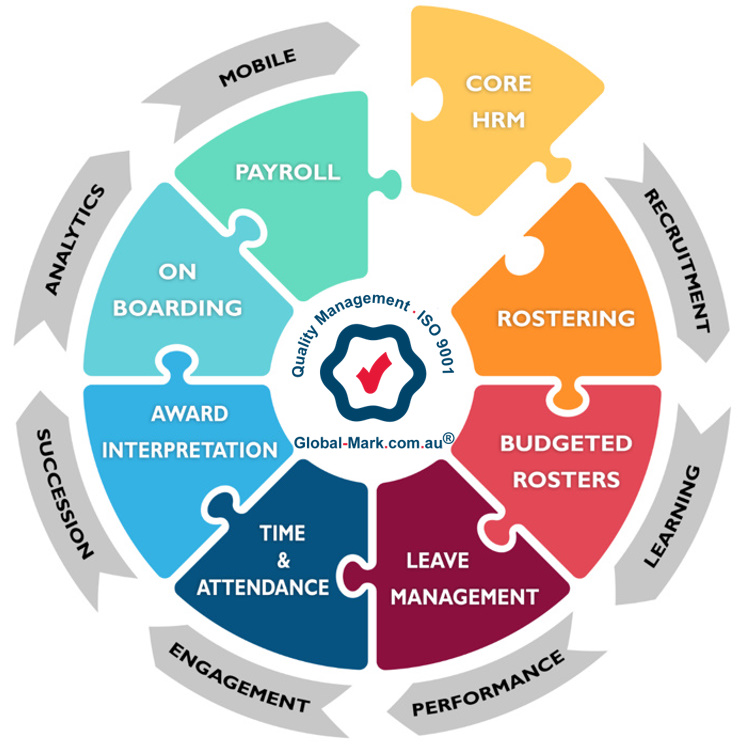
The system needs all of the following data elements to accurately undertake payroll production
What to Look for in Award Interpretation Software
Until independent verification becomes available, businesses should evaluate award interpretation tools with caution. Key factors to consider include:
-
Automated updates via the Fair Work API or equivalent – Inzenius has this feature
-
Industry focus that matches your business –
-
Integration with your existing payroll, rostering, and time-and-attendance systems – seamless data flow reduces manual entry errors.
-
A human audit trail – your payroll team should be able to review and override any automated calculation.
-
Vendor support – established vendors with dedicated implementation services offer more accountability.
Even within covered awards, a tool may not correctly interpret clauses that are open to employer or employee discretion. Always verify critical calculations manually during the first few pay cycles.
The Safer Approach: Human-in-the-Loop
The most prudent strategy for Australian payroll is a hybrid model. AI award interpretation software can handle repetitive tasks such as verifying base rates, flagging overtime triggers, and generating audit-ready timesheets. Workstem, for example, automates compliance verification at intervals that match common pay periods – daily, weekly, fortnightly or monthly. This automation reduces manual work but should never be the final sign-off. A trained payroll officer or manager must review the output, especially for new employees, complex rosters, or when awards change. The Australian industrial relations environment updates regularly – several vendors promise real-time monitoring via Fair Work API or a native AI layer like Inzenius’ AI. Even with real-time updates, human judgment is needed to interpret ambiguous clauses or to apply enterprise agreements that differ from the standard award.
Payroll managers who adopt award interpretation tools as assistants rather than replacements will gain efficiency without sacrificing accuracy. The software handles the heavy lifting of data processing and initial calculation, while the human applies the final check. This approach acknowledges that no system, regardless of how advanced its AI claims, can guarantee 100 per cent compliance in an environment where the cost of error is direct back-pay liability.

Frequently Asked Questions
Can AI completely replace human payroll managers?
Not yet. The available tools can automate significant portions of award interpretation and compliance verification, but no vendor provides independent accuracy guarantees. Penalties for payroll errors are severe, and the complexity of Australian awards requires human judgment. A hybrid model in which AI assists, but a qualified payroll professional reviews the output, remains the safest practice.
How often do award interpretations change?
Modern awards and enterprise agreements are updated regularly by the Fair Work Commission. Inzenius use automated feeds from the Fair Work API or native AI layers to stay current. Even with real-time updates, changes to rates and conditions require human verification to ensure the software’s logic has correctly applied the new rules.
What are the main risks of using only AI for payroll?
The primary risks are unknown error rates, lack of independent verification, and the inability of generic AI to handle nuanced award clauses. A Reddit user reported that ChatGPT could not accurately answer questions about penalty rates under the Hospitality Award. If a tool misinterprets a rule, underpayment can occur across an entire workforce, leading to enforcement action and back-pay orders.
How can I ensure my award interpretation tool stays up to date?
Inzenius will connect directly to the Fair Work API for automatic updates to rates and rules. Even with automated updates, schedule a manual audit of the tool’s output at least once per quarter, particularly when the Fair Work Commission announces a new decision or variation.