

What is the Impact of a FWO Enforceable Undertaking on the Business?
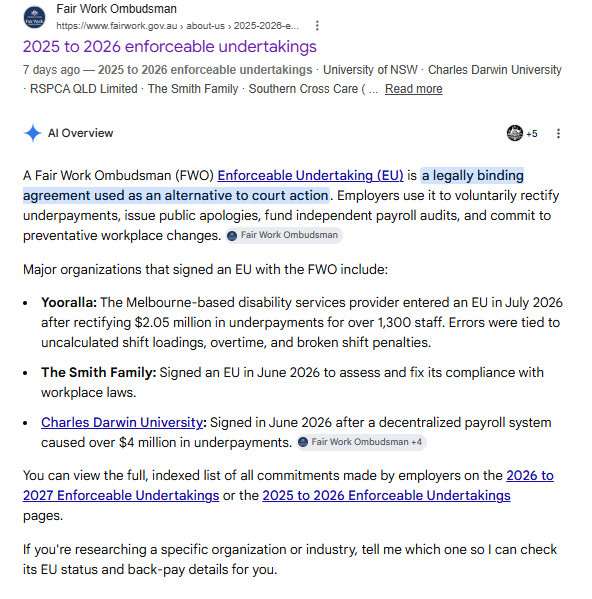
An enforceable undertaking from the Fair Work Ombudsman (FWO) is a formal, legally binding agreement that a business enters into after a contravention of workplace laws. While it avoids full court proceedings, it carries significant consequences: public naming, mandatory corrective actions, and often substantial back-payment obligations and costs. For many employers, wage underpayments are the trigger, and once the FWO investigates, an enforceable undertaking can be difficult to escape. Understanding how to prevent wage errors before they occur is therefore critical, and automated award interpretation plays a central role in that prevention.
The Real Cost of an Enforceable Undertaking
A FWO enforceable undertaking is not a fine, but it is not a slap on the wrist either. The business must agree to a range of remedial measures: auditing all affected employees, rectifying underpayments with interest and superannuation, implementing robust compliance systems, engaging external auditors, and often displaying a public notice. The process is expensive, time-consuming, and damaging to reputation. For a medium-sized business in hospitality or healthcare, the total cost can run into hundreds of thousands of dollars before the back-payment figure. Worse, the FWO publishes every enforceable undertaking on its website, making the company’s compliance failure a permanent public record.
Beyond the financial hit, executives may face personal liability. Directors and HR managers can be named in proceedings or required to attend training. The operational disruption is also severe: payroll teams must halt normal processing while reviews are underway, and staff morale suffers when underpayments are revealed. Avoiding an enforceable undertaking is far more than a legal preference; it is a commercial necessity.
How Wage Underpayments Happen
The overwhelming majority of wage underpayments in Australia stem from the complex interpretation of awards. Modern awards came into effect on 1 January 2010 and there are currently 122 industry or occupation awards covering most Australian workers. These awards outline pay rates, hours of work, rosters, breaks, allowances, penalty rates, and overtime rules. Manually applying these conditions across a rotating workforce is prone to error, particularly when multiple awards apply, employees have changing classifications, or conditions vary by day and shift time.
Common mistakes include misclassifying an employee under the wrong classification level, failing to apply the correct penalty rate for weekend or public holiday work, overlooking allowances, and miscalculating overtime thresholds. For junior and apprentice employees, rates change with age and skill progression, adding another layer of complexity. Even diligent payroll officers can miss updates to awards from Fair Work Commission rulings. These errors accumulate over pay cycles, and by the time an internal audit or FWO investigation occurs, the underpayment figure can be substantial.
The Role of Manual Processes
Businesses relying on spreadsheets or basic payroll software that lacks award logic are especially vulnerable. Manual data entry invites transposition errors, and calculating penalty rates by hand across a weekly roster of dozens or hundreds of staff is impractical. The risk increases in industries with high casual employment, irregular shift patterns, or labour costs exceeding 30% of revenue, precisely the sectors the FWO targets with proactive compliance campaigns.
Even businesses using payroll software may be exposed if the system does not automatically interpret award clauses. Many off-the-shelf payroll platforms require the user to set up rates and rules manually, creating the same opportunities for error. The gap between having payroll software and having compliant payroll software is where enforceable undertakings start.
Automated Award Interpretation as a Prevention Strategy
Automated award interpretation converts Modern Award clauses into system rules that the payroll software can apply automatically. Instead of a payroll officer manually checking whether the age-17 junior rate or the 5 pm Monday penalty applies, the software reads the roster data and applies the correct rate in real time. This approach eliminates the most common human errors that lead to underpayments and, by extension, enforceable undertakings.
Several Australian software vendors offer award interpretation engines, each with capabilities that can help businesses maintain compliance. While pricing and exact feature sets vary, the common goal is to reduce manual intervention and keep pay calculations aligned with award conditions.
Key Features That Protect Against Underpayments
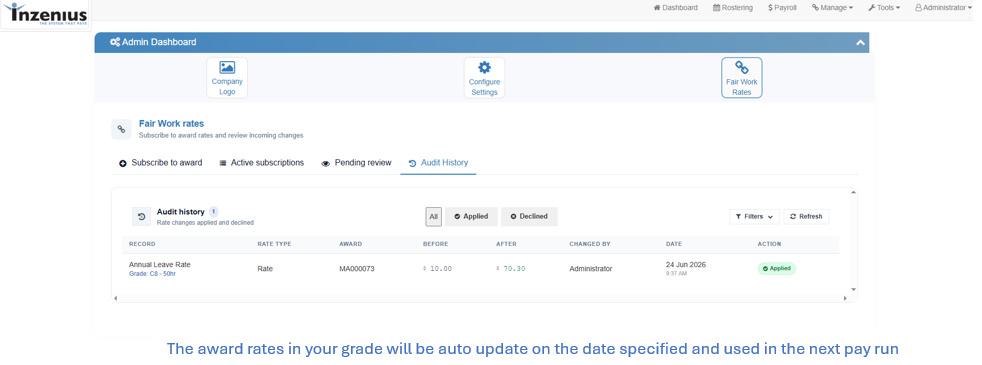
Automated award interpretation software typically handles several high-risk areas. First, it automatically adjusts pay rates based on FWO published award rates. This feature is offered by Inzenius. Second, it progresses to the next level rates by selected date for each level and competency stage, a task that manual systems often miss. Third, it applies correct penalty rates, overtime, and allowances based on the exact time and day the employee worked as recorded in the timesheet, even where the employee works on different award condition rates in the one shift
Inzenius also support multi-award payments within the same pay cycle, which is essential when an employee performs different duties under different awards. Salary annualisation tracking, offered by Inzenius, ensures that employees on annual salaries receive at least the minimum award entitlement for hours worked. Real-time costing, highlighted, allows employers to see the labour cost impact of a roster before the shift is worked, making it easier to stay within budget and award rules simultaneously.
Penalty for Wage Theft
In addition to the remedial back payment of wages, super, etc., penalties may be imposed if the underpayment resulted from a systemic process in which the employer and their management knew or should have known that the underpayment was permitted.
Deliberately underpaying employees is a criminal offence investigated by the Fair Work Ombudsman (FWO). If convicted, employers face severe criminal penalties: [1, 2, 3]
-
Individuals: Up to 10 years in prison, and fines of up to $1.65 million or three times the underpayment amount, whichever is greater.
-
Companies: Fines up to $8.25 million or three times the underpayment amount, whichever is greater. [1]
In addition to criminal prosecution, the FWO continues to seek strict civil penalties. Under recent legislation, civil penalties are substantially higher, scaling to three times the value of the underpayment or five times for certain serious contraventions by businesses with 15 or more employees. [1, 2]
Choosing the Right Award Interpretation Tool
Choosing the Right Award Interpretation Tool
When evaluating options, consider whether the software is kept up to date with changes from the Fair Work Commission (FWO). Inzenius will enable automatic updates from the award published FWO rates for each business award wage condition at each grade level to be paid, or in the case of a salaried employee, for the BOOT test .
As new conditions or rates are applied to an award, Inzenius maintains the ability to automate the process, as the BOOT and Payday Super Sleep Over interpretation requirements were introduced in 2026
Not all award interpretation solutions are identical. Inzenius is the standout award interpreter with its comprehensive and compliant payroll and leave automated award interpretation directly from each employee’s timesheet
The Inzenius processing model is an extreme value for money, as it automates the application of timesheet rules and enables the direct Better Off Overall Test (BOOT) to the award for hourly and salaried paid employees each pay run.
Inzenius delivers payroll processing efficiency by up to 70%. incorporating rostering, timekeeping, and payroll into one system, eliminating the need to build APIs or undertake off-system calculations and/or data entry.
Reference of the Inzenius Value
“ Here we are now with, not only a better overall ERP/Inzenius system that is now delivering up to a 70% reduction in data duplication and entry across a number of systems in payroll processing time and effort, we have achieved additional improved functionality overall.” Grant DSummers Incognitus CFO
When evaluating options, consider whether the software is kept up to date with changes from the Fair Work Commission. Inzenius will enable automatic updates to the rates for each business award wage comditions at each grade level.
Beyond Software: Building a Compliance Culture
Automated award interpretation is a powerful tool, but it works best as part of a broader compliance framework. Regular internal audits, ongoing training for payroll and HR staff, and clear escalation paths for discrepancies all complement the technology. The FWO expects businesses to take proactive steps, not just react when notified. An enforceable undertaking often requires the business to engage an external auditor and implement new systems; it is far cheaper to put those systems in place beforehand.
Remember that the FWO publishes details of enforceable undertakings. A public record of underpayment can affect your ability to win tenders, retain staff, and maintain client trust. In industries like healthcare, where many employees are covered by awards, and hospitality, where margins are tight and casual workers are common, the stakes are especially high. An investment in award interpretation software is an investment in avoiding that public embarrassment and the costly remediation process that follows.
Frequently Asked Questions
What is an FWO enforceable undertaking?
An enforceable undertaking is a legally binding agreement between the Fair Work Ombudsman and a business that has contravened workplace laws. It requires the business to take corrective action, such as backpaying employees, engaging auditors, and improving compliance systems, instead of facing court proceedings. The terms are published on the FWO website.
How does automated award interpretation prevent underpayments?
Automated award interpretation converts Modern Award clauses into software rules that automatically calculate pay rates, penalties, and allowances. This removes the risk of manual errors in complex award conditions, such as age-based rate changes, apprentice progression, and multi-award payments. Applying the correct rates every pay cycle significantly reduces the risk of underpayment that could trigger an FWO investigation.
Is award interpretation software mandatory for Australian businesses?
No law requires you to use award interpretation software. However, all employers must comply with applicable Modern Awards and the Fair Work Act. Given the complexity of 122 awards and frequent Fair Work Commission updates, many businesses find that manual or basic payroll systems cannot reliably maintain compliance. The software is a compliance aid, not a legal requirement, but it is strongly recommended for businesses with variable rosters or multiple award classifications.