

Payday Super and STP changes will aid the ATO in data matching compliance for payroll and tax
From 1 July 2026, the way employers report and pay superannuation guarantee in Australia changes significantly. The ATO will use Single Touch Payroll (STP) data and the new Payday Super framework not only to monitor super obligations but also to investigate employee underpayments and business tax compliance. Understanding how the ATO uses these records is essential for any employer who wants to stay compliant and avoid penalties.
What is Payday Super and when does it start?
Payday Super requires employers to pay their employees’ superannuation guarantee contributions at the same time as salary and wages – generally within seven business days after each payday. From 1 July 2026, employers must also report year-to-date (YTD) amounts of qualifying earnings through STP. This is a fundamental shift from the current quarterly system, where super was due by the 28th day of the month following the end of each quarter. The new system brings super in line with payroll reporting, giving the ATO near real-time visibility into employer obligations.
How the ATO uses STP 3 data to monitor compliance
The ATO matches the data reported through STP with information received directly from superannuation funds. This allows the ATO to determine whether the minimum super guarantee contributions have been paid, including the actual date the super fund received the money. By comparing the payday reported in STP with the date super is received, the ATO can identify missed, late, or underpaid contributions. The ATO can also calculate the qualifying earnings amount for a specific payday by subtracting the previous period’s YTD qualifying earnings from the current period’s YTD qualifying earnings, making the cross-check highly precise.
Possible Future STP Enhancements That May be Introduced
Originally, I believed STP 2 included the working hours for each employee that were removed after an industry push pack. This data would have enabled the validation of employees’ working hours with each of their pay rates when matched with the pay classification they were working under.
Is there an STP 4 plan that will introduce further data matching of employees’ payroll records?
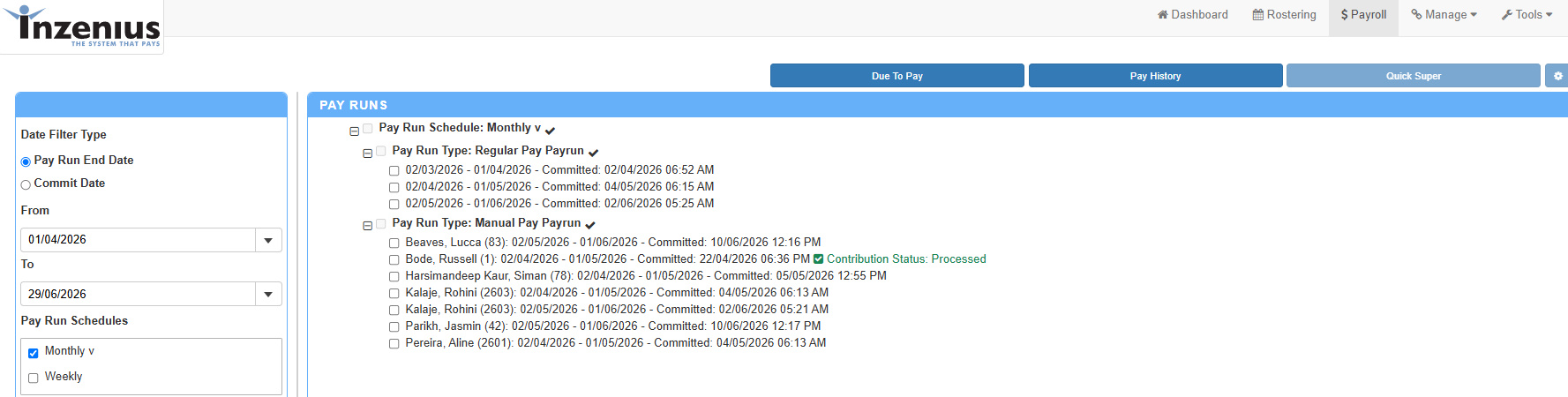
I believe the ATO will introduce STP 4 to help measure declared wages, with a statutory requirement to maintain accurate employee timekeeping records that can be matched to such STP times worked data. Russell Bode, Director of Innovation, Inzenius
Data matching in near real time
Under the quarterly system, the ATO could only check super compliance well after the fact – often months later. With Payday Super, each STP pay event triggers a near real-time assessment. The ATO uses the payday information from your STP report to set the deadline for when that contribution must be received by the super fund. If the contribution is not received within seven business days, the system can flag it for review almost immediately.
The shift from quarterly to payday-based super
The differences between the old quarterly super rules and Payday Super are substantial. The table below summarises the key changes.
|
Aspect |
Quarterly super (before 1 July 2026) |
Payday Super (from 1 July 2026) |
|---|---|---|
|
Earnings base |
Ordinary time earnings (OTE) |
Qualifying earnings (QE) – includes OTE, salary sacrifice, and some contractor payments |
|
Payment frequency |
Due by 28th of month after quarter end |
Due within 7 business days after each payday |
|
Reporting timing |
Quarterly STP reports |
YTD qualifying earnings reported each payday via STP |
|
Late payment offset |
Available until 30 June 2026 |
Removed for the final June 2026 quarter and subsequent periods |
|
Clearing house |
Small Business Superannuation Clearing House (SBSCH) available |
SBSCH closes permanently on 30 June 2026 |
Employers who previously relied on the SBSCH must arrange alternative payment methods before the closure date. The ATO recommends using a commercial clearing house or making direct payments via SuperStream, which now includes faster payment options through the New Payments Platform (NPP) and clearer error messages via the Member Verification Request (MVR) service.
What the ATO will investigate in the first year
For the first year of Payday Super – covering qualifying earnings days from 1 July 2026 to 30 June 2027 – the ATO has stated it will focus its compliance activities on high-risk employers. These are employers who have not paid the minimum super guarantee or any super at all. The ATO has also publicly indicated that employers who make genuine efforts to pay on time and fix any errors will not be the focus of compliance action in the first year. This gives businesses a transition window to adapt their payroll processes, but it is not a free pass. The ATO will still expect accurate reporting and on-time payments.
What the ATO’s data can reveal about underpayments
The ATO’s ability to match STP data with super fund data also supports investigations into broader employee underpayments. Because STP records include gross earnings, tax withheld, and super contributions, any mismatch between these figures can indicate that wages or super have been underpaid. For example, if an employee’s reported gross earnings in STP do not align with the qualifying earnings used to calculate super, the ATO can investigate further. While the primary focus of Payday Super is super compliance, the data is also relevant to the ATO’s wider role in ensuring correct tax withholdings and payments under PAYG withholding.

Record-keeping requirements under Payday Super
Employers must keep superannuation contribution and choice records for at least five years. This includes records of contributions paid, the dates they were sent, and evidence that the money reached the super fund within the seven-business-day window. With the ATO now able to cross-reference STP pay event data with fund receipts, accurate record keeping is more important than ever. If an employer cannot demonstrate that payments were made on time, the ATO may issue a super guarantee charge (SGC), which attracts interest and penalties for ongoing or repeated non-compliance.
https://www.fairwork.gov.au/pay-and-wages/paying-wages/record-keeping

How to prepare your business
To remain compliant with Payday Super and avoid unexpected attention from the ATO, employers should review their payroll systems well before 1 July 2026. Key steps include:
-
Ensuring your STP software can report YTD qualifying earnings each pay run.
-
Choosing a payment method that reliably transfers super contributions to funds within seven business days, such as using SuperStream with a commercial clearing house or direct payments via the NPP.
-
Reconciling STP-reported amounts with actual super fund receipts each pay period.
-
Updating internal processes to account for the change from ordinary time earnings to qualifying earnings when calculating super guarantee.
-
Training payroll staff on the new deadlines and the ATO’s data matching capabilities.
Businesses that rely on integrated payroll, rostering, and time-and-attendance software can automate much of this compliance burden. Accurate award interpretation and timesheet capture help ensure that the earnings data flowing into STP is correct from the start, reducing the risk of ATO data mismatches.
Frequently Asked Questions
What is qualifying earnings (QE) and how does it differ from ordinary time earnings?
Qualifying earnings replace ordinary time earnings for calculating super guarantee under Payday Super. QE includes ordinary time earnings plus salary sacrifice amounts and certain contractor payments. The ATO uses the YTD qualifying earnings reported through STP to calculate super obligations for each pay period.
Will the ATO penalise me if I make an honest mistake in the first year?
The ATO has said it will focus on high-risk employers who have not paid the minimum or any super guarantee during the first year. Employers who make genuine efforts to pay on time and promptly correct errors will not be the main target of compliance action, although they should still aim to meet all obligations.
What happens if my super payment arrives one day late under Payday Super?
If a super contribution is not received by the fund within seven business days after the employee’s payday, the ATO can treat it as a late payment. The super guarantee charge (SGC) may apply, along with interest and penalties. The ATO’s data matching system will flag late payments automatically based on the payday reported in STP.
Do I still need to keep paper records of super contributions?
Yes. Employers must keep super contribution and choice records for at least five years. This includes evidence of payment dates and amounts. Although the ATO can access digital data from STP and super funds, maintaining your own complete records is required by law and helps you respond to any queries.
How does the closure of the Small Business Superannuation Clearing House affect me?
The Small Business Superannuation Clearing House will close permanently on 30 June 2026. Employers currently using that service must arrange an alternative payment method before that date, such as a commercial clearing house or direct SuperStream payments. The ATO recommends setting up new arrangements well in advance to avoid disruption.
Preparing for Payday Super and understanding the ATO’s use of STP records is one of the most important compliance tasks for Australian employers in 2026. By aligning your payroll processes with the new requirements now, you can reduce the risk of underpayment investigations and ensure your business is ready for the future of super guarantee reporting.